
- Follicular Stage (Days 1-14)
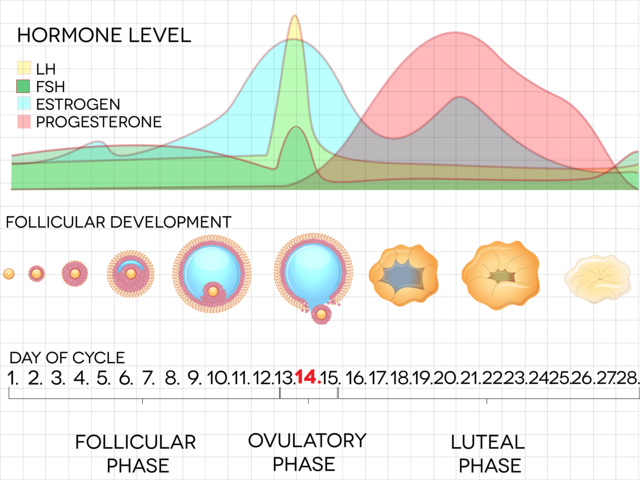
This period of the menstrual cycle happens from around day 1-14. Day 1 is the primary day of brilliant red dying, and the finish of this stage is set apart by ovulation. While menstrual draining happens in the early piece of this stage, the ovaries are all the while getting ready to ovulate once more. The pituitary organ (situated at the base of the mind) discharges a hormone called FSH – follicle animating hormone. This hormone causes a few ‘follicles’ to ascend on the outside of the ovary. These liquid filled “knocks” each contain an egg. In the long run, one of these follicle ends up overwhelming and inside it builds up a solitary develop egg; different follicles shrivel back. In the event that more than one follicle achieves development, this can prompt twins or more. The developing follicle creates the hormone estrogen, which increments over the follicular stage and tops in the day or two before ovulation. The coating of the uterus (endometrium) ends up thicker and more advanced with blood in the second piece of this stage (after period is finished), in light of expanding dimensions of estrogen. Large amounts of estrogen animate the generation of gonadotropin-discharging hormone (GnRH), which thusly invigorates the pituitary organ to emit luteinizing hormone (LH). On about day 12, floods in LH and FSH cause the egg to be discharged from the follicle. The flood in LH likewise causes a short flood in testosterone, which expands sex drive, directly at the most prolific time of the cycle.
- Ovulatory Stage (Day 14)
The arrival of the develop egg occurs on about day 14 because of a flood in LH and FSH over the earlier day. After discharge, the egg enters the fallopian tube where preparation may happen, if sperm are available. On the off chance that the egg isn’t prepared, it breaks down after around 24 hours. When the egg is discharged, the follicle seals over and this is known as the corpus luteum.
- Luteal Stage (Days 14-28)
After the arrival of the egg, dimensions of FSH and LH decline. The corpus luteum produces progesterone. In the event that treatment has happened, the corpus luteum keeps on creating progesterone which keeps the endometrial coating from being shed. In the event that treatment has not happened, the corpus luteum crumbles, which causes progesterone levels to drop and flag the endometrial coating to start shedding.


You must be logged in to post a comment.