Marine life can be susceptible to noise or the sound pollution from sources such as passing ships, oil exploration seismic surveys, and naval low-frequency active sonar. Sound travels more rapidly and over larger distances in the sea than in the atmosphere. Marine animals, such as cetaceans, often have weak eyesight, and live in a world largely defined by acoustic information. This applies also to many deeper sea fish, who live in a world of darkness.[98] Between 1950 and 1975, ambient noise at one location in the Pacific Ocean increased by about ten decibels (that is a tenfold increase in intensity).[99]
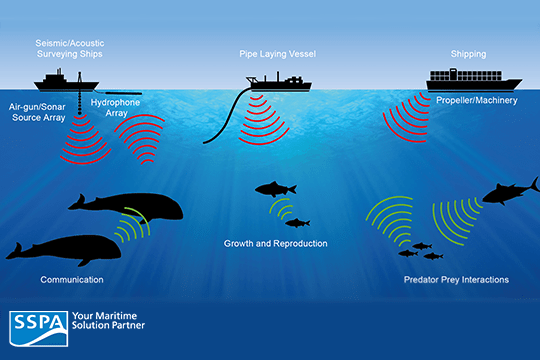
Noise also makes species communicate louder, which is called the Lombard vocal response.[100] Whale songs are longer when submarine-detectors are on.[101] If creatures don’t “speak” loud enough, their voice can be masked by anthropogenic sounds. These unheard voices might be warnings, finding of prey, or preparations of net-bubbling. When one species begins speaking louder, it will mask other species voices, causing the whole ecosystem to eventually speak louder.[102]
According to the oceanographer Sylvia Earle, “Undersea noise pollution is like the death of a thousand cuts. Each sound in itself may not be a matter of critical concern, but taken all together, the noise from shipping, seismic surveys, and military activity is creating a totally different environment than existed even 50 years ago. That high level of noise is bound to have a hard, sweeping impact on life in the sea.”[103]
Noise from ships and human activity can damage Cnidarians and Ctenophora, which are very important organisms in the marine ecosystem. They promote high diversity and they are used as models for ecology and biology because of their simple structures. When there is underwater noise, the vibrations in the water damage the cilia hairs in the Coelenterates. In a study, the organisms were exposed to sound waves for different numbers of times and the results showed that damaged hair cells were extruded or missing or presented bent, flaccid or missed kinocilia and stereocilia.[104]


You must be logged in to post a comment.