One of the most important questions in climate science is: How do we know that humans are responsible for global warming?
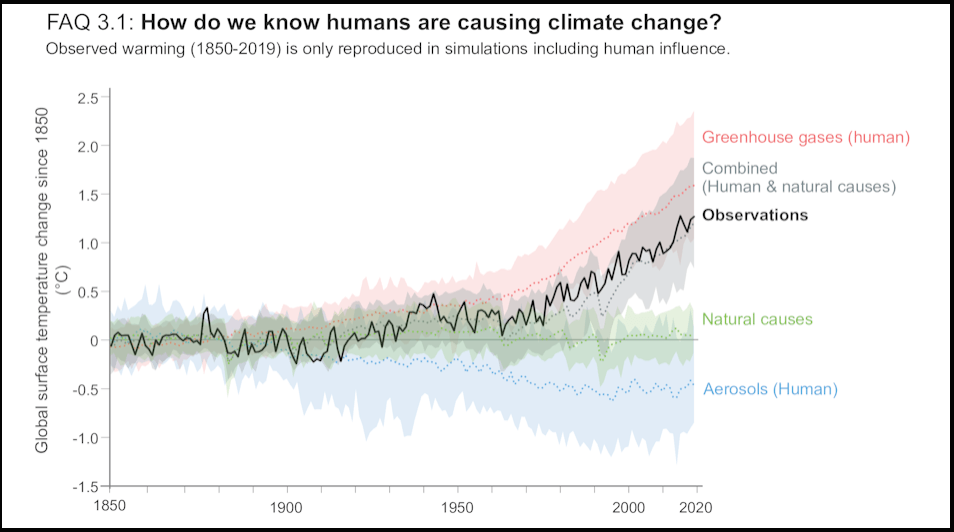
The answer lies in decades of detailed observations and simulations — like the graph shown above — that compare natural and human influences on Earth’s temperature.
Let’s explore what this graph tells us.
📊 Understanding the Graph
The graph shows global surface temperature change from 1850 to 2019 compared to pre-industrial levels, broken down by different factors:
- Greenhouse gases (human influence) — shown in red
- Natural causes like volcanic activity and solar changes — shown in green
- Human aerosols (pollutants that cool the atmosphere) — shown in blue
- Combined human and natural causes — shown in gray
- Actual observations — shown as a solid black line
🔍 Key Insights
1. Natural Causes Alone Cannot Explain Warming
If only natural causes (like solar activity and volcanic eruptions) were at work, Earth’s temperature would have stayed relatively stable, as shown by the green shaded area.
Natural factors alone do not account for the steep rise in global temperatures seen after the 1950s.
2. Human Factors Match Observed Warming
The black line (real-world observations) closely follows the gray shaded area, which represents human and natural causes combined.
This means that climate models only match reality when human activities — particularly greenhouse gas emissions — are included.
3. Greenhouse Gases Are the Major Driver
The red shaded area shows that greenhouse gases alone would have caused even more warming if it weren’t partially offset by human aerosols (blue area), which reflect sunlight and temporarily cool the atmosphere.
Thus, the main driver of recent climate change is the accumulation of human-produced greenhouse gases like carbon dioxide (CO₂), methane (CH₄), and nitrous oxide (N₂O).
🌟 Why This Matters
✅ Clear Evidence:
This graph provides clear, scientific evidence that human activities — not just natural variability — are causing the planet to warm.
✅ Policy Relevance:
Recognizing human responsibility is crucial for creating effective policies to reduce emissions, shift to renewable energy, and adapt to climate change.
✅ Moral Responsibility:
Understanding our role empowers us to take collective action for a safer, healthier future.
📚 Final Thoughts
Climate science has evolved through rigorous testing, observations, and modeling.
The overwhelming conclusion:
🌍 Humans are the primary cause of climate change — and we have the power to change the future.
Source: IPCC Sixth Assessment Report (AR6), Working Group I – FAQ 3.1


You must be logged in to post a comment.