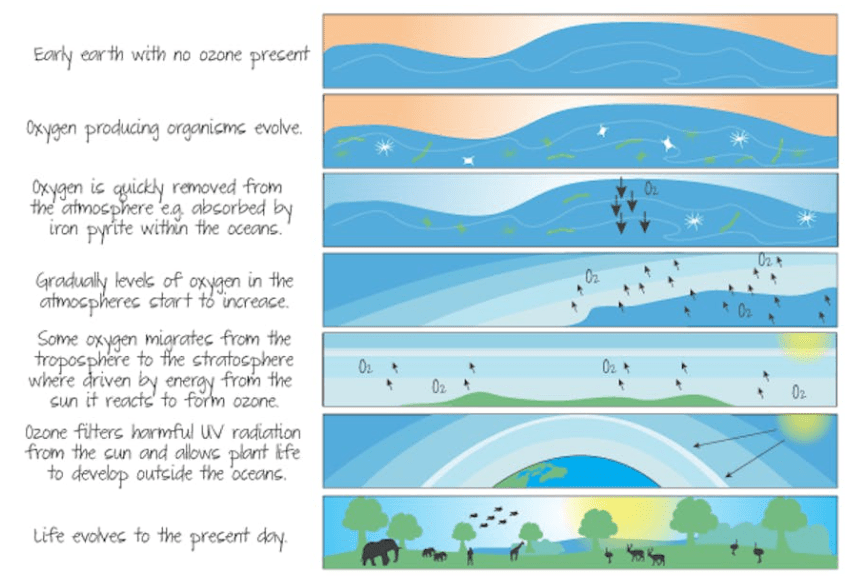
The stratospheric ozone layer is often called Earth’s “natural sunscreen.” But beyond shielding life from harmful ultraviolet radiation, its formation played a crucial role in the evolution of complex organisms on our planet.
☀️ How Did the Stratospheric Ozone Layer Develop?
🧪 1. The Rise of Oxygen (Great Oxygenation Event)
- About 2.4 billion years ago, photosynthetic microorganisms called cyanobacteria began releasing oxygen (O₂) into Earth’s atmosphere.
- Over time, atmospheric oxygen increased, especially after 600 million years ago.
🔆 2. Ozone Formation in the Stratosphere
Once enough oxygen was present, UV radiation from the Sun began interacting with O₂ in the upper atmosphere, triggering ozone formation:O2+UV-C→O+O(oxygen molecules split)O2+UV-C→O+O(oxygen molecules split)O+O2→O3(ozone forms)O+O2→O3(ozone forms)
This ozone layer formed in the stratosphere (10–50 km above Earth’s surface) and created a protective shield against UV radiation.
🧬 Impact on Evolution of Life
The formation of the ozone layer had a profound evolutionary impact, particularly during the Cambrian explosion (~540 million years ago):
🦠 1. Protection from UV Radiation
- Before ozone, intense UV radiation made life on land impossible.
- With ozone absorbing UV-B and UV-C rays, the surface became safe for life to exist and evolve outside water.
🐚 2. Colonization of Land
- Organisms could migrate from oceans to land, leading to the evolution of amphibians, reptiles, insects, and eventually mammals and birds.
- Plants also colonized land, producing more oxygen and stabilizing ecosystems.
🌿 3. Increased Genetic Diversity
- By reducing harmful mutations from UV exposure, the ozone layer allowed more stable DNA replication, supporting the development of more complex, multicellular organisms.
⚠️ Why Ozone Still Matters Today
- The ozone layer remains essential for protecting current life from harmful solar radiation.
- Human-made chemicals (like CFCs) damaged this layer in the 20th century, causing the Antarctic ozone hole.
- Global efforts, like the Montreal Protocol (1987), helped reduce ozone-depleting substances, showing how human action can positively influence Earth’s systems.
🧭 Final Thought
The development of the stratospheric ozone layer was a turning point in Earth’s history, enabling life to flourish and evolve on land. It’s a reminder that Earth’s atmosphere is not just air—it’s a living system that shapes and protects all forms of life.


You must be logged in to post a comment.