
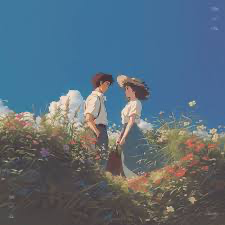
Chapter 3: Paper Hearts
Spring in Willow Creek came slowly, like a shy guest arriving at a party. Snow melted into rivulets that fed the river, grass peeked out in stubborn patches, and the trees wore halos of new green.
Mae turned fifteen in March. It rained that day—the soft kind of rain that smells like mud and hope. She didn’t plan a party. She didn’t want cake or decorations. All she wanted was the bridge, Leo, and the feeling that maybe, somehow, she hadn’t been forgotten by the world after all.
When she got to the bridge after lunch, Leo was already there.
He was soaking wet, perched on the middle plank, holding something above his head like a trophy: a battered shoebox, protected (barely) by a plastic grocery bag.
“You’re late!” he shouted over the rain.
Mae sprinted the last few steps, laughing breathlessly. “You’re crazy!”
“True,” he said, beaming, “but also heroic. I saved your birthday present from drowning.”
She clambered up onto the bridge and sat beside him, shivering as rain trickled down her sleeves. He handed her the shoebox with a theatrical bow.
“Happy Birthday, Your Majesty.”
Mae peeled away the wet plastic. Inside, she found paper hearts—dozens of them—each one hand-folded from notebook pages, candy wrappers, maps, receipts, anything Leo could find.
Some were tiny and delicate, others clumsy and big. Each heart had a word or a phrase scribbled across it:
Wild.
Here.
Stay brave.
You are not invisible.
Mae’s throat tightened as she dug deeper. Nestled at the bottom of the box was a folded napkin heart that simply said:
I miss you when you’re not around.
She looked up at him, blinking rain and tears from her eyes. “You made all these?”
Leo shrugged, but his cheeks flushed pink. “Figured you’d need extra wishes this year.”
Mae couldn’t speak for a long moment. She just hugged the box to her chest, trying to absorb the way this moment felt—the river roaring beneath them, the rain painting their hair to their faces, the world both messy and perfect at once.
“You’re the weirdest person I know,” she finally said, voice thick.
“Good,” Leo said with a grin. “Means I’m doing my job.”
They sat there for hours, even after the rain slowed and the clouds broke open to reveal a bruised purple sunset. Mae leaned her head on his shoulder, feeling the steady rhythm of his breath against hers.
They didn’t need to say I love you.
It was written between every fold of those paper hearts.
The Paper Kingdom evolved that spring.
Their old hideout, battered by winter storms, was rebuilt with stronger wood, better nails, and cautious optimism. They added a second story—or at least what counted as a second story: a creaky platform reachable by a rope ladder Leo made from fraying jump ropes.
Inside, the walls were covered with sketches and wishes. Leo hung a broken wind chime from the roof. Mae painted the door bright yellow.
“You know,” Leo said one afternoon, sprawled across the floor, “we should make it official.”
“Make what official?”
“Our Kingdom. We need…like, rules.”
Mae raised an eyebrow. “Rules for a secret hideout?”
“Yeah. Important stuff. Like… ‘No Sadness Allowed.’”
She laughed. “That’s impossible.”
“Fine. ‘No sadness without snacks allowed.’”
Mae pretended to consider. “Acceptable.”
They spent an entire afternoon writing out their Constitution of the Paper Kingdom:
- First: Wishes must be made with serious hope.
- Second: Secrets shared inside must stay inside.
- Third: Sadness is allowed, but must be accompanied by candy.
- Fourth: Leaving forever is against the rules—unless you leave a really good map.
Mae taped it to the wall with colorful washi tape Leo “borrowed” from his grandma’s craft closet.
Sometimes, creating a tiny world helped them survive the big one.
But even paper hearts have thin edges.
As summer approached, life outside the Paper Kingdom began creeping in again.
Mae’s mom picked up extra shifts at the diner. Bills piled up on the counter. The tension in the house grew louder, harder to ignore.
Leo, too, seemed more distracted. He sometimes showed up with bruises he wouldn’t explain. Once, Mae saw him flinch when his phone buzzed in his pocket.
“You okay?” she asked after he winced at a late-night call one evening.
“Yeah. Just…stuff,” he muttered.
She wanted to press him. She wanted him to know he didn’t have to carry everything alone.
But the Paper Kingdom’s second rule echoed in her mind: secrets shared inside must stay inside.
Maybe some secrets weren’t ready yet.
In late June, the carnival came to town.
It was a big deal for Willow Creek—rides, food trucks, a band that played covers of 80s songs slightly out of tune. Mae hadn’t planned to go, but Leo insisted.
“Come on,” he said, nudging her shoulder. “You can’t be a true Willow Creek kid until you puke on the Tilt-a-Whirl.”
They met just after sunset, when the air smelled like popcorn and dust. Mae wore a yellow sundress that matched the Paper Kingdom door. Leo wore a jacket that was too big for him but somehow suited him perfectly.
They rode the Ferris wheel three times, argued over whether cotton candy was food or art, and spent nearly an hour trying to win a stuffed dinosaur from the rigged ring toss.
At the end of the night, they stood at the edge of the crowd, fireworks exploding overhead in blooms of red and blue.
Mae felt the warmth of Leo’s hand brush against hers. Not grabbing. Just… there. Waiting.
She took it.
No words.
Just sparks, both in the sky and under her skin.
Leo looked at her, and it was different this time. He wasn’t teasing or joking or hiding.
He was seeing her.
And she—awkward, bruised, hopeful—was letting him.
The fireworks ended. The world exhaled.
They stayed standing there long after the last light faded, hands still entwined.
Later that night, Mae tucked the dinosaur prize onto her bed, next to the shoebox of paper hearts.
She opened one, the napkin heart she had read first: I miss you when you’re not around.
And for the first time in a long while, she didn’t feel lonely.
But something was shifting. Something she couldn’t name yet.
Not everything could be captured in paper and glue.
Not every wish could hold back time.
And deep down, Mae had the sinking feeling that the harder you tried to clutch something, the more likely it was to slip through your fingers.
But for now, she let herself believe.
She let herself hope.
Because sometimes, hope was all you had—and sometimes, it was enough.


You must be logged in to post a comment.