High above us, the atmosphere is busy performing a quiet miracle: protecting all life on Earth from the harmful effects of the Sun’s ultraviolet (UV) radiation. One of the key players in this invisible defense system is the ozone layer — and understanding how it works is crucial for climate science, human health, and environmental protection.
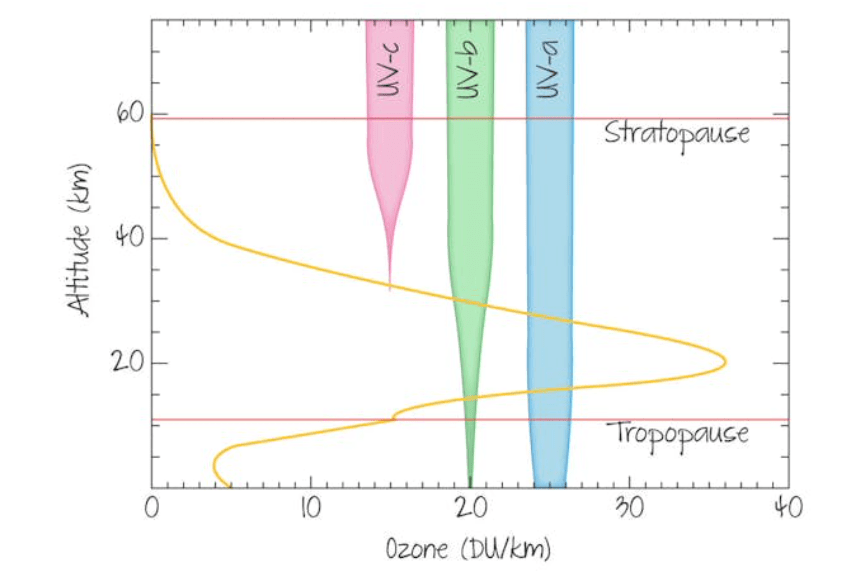
Let’s explore what the graph above tells us about ozone concentration, UV radiation types, and atmospheric layers.
📊 Decoding the Graph
1. X-Axis (Bottom): Ozone Concentration
- Measured in Dobson Units per kilometer (DU/km).
- Indicates the density of ozone at various altitudes.
2. Y-Axis (Left): Altitude (km)
- Ranges from 0 to 60 km, covering the troposphere (surface to ~12 km) and stratosphere (~12 km to 50 km).
3. Color Bands: Types of UV Radiation
- UV-a (Blue): Least harmful; reaches Earth’s surface.
- UV-b (Green): Partially absorbed by the ozone layer; excess exposure can cause skin cancer.
- UV-c (Pink): Most dangerous but completely absorbed by the ozone layer.
4. Ozone Curve (Yellow Line)
- Shows ozone concentration peaking around 20–30 km in altitude — a region within the stratosphere.
☂️ Why the Ozone Layer Matters
✅ Natural Sunscreen
The ozone layer absorbs the majority of UV-b and UV-c radiation, preventing it from reaching the Earth’s surface. Without it, life would face dangerous levels of radiation.
✅ Location is Key
The highest concentration of ozone is in the lower stratosphere (15–30 km), which aligns with the region where UV-c and most of UV-b are absorbed.
✅ Troposphere vs. Stratosphere
While weather occurs in the troposphere, ozone mostly resides in the stratosphere, acting as a buffer between incoming UV radiation and Earth.
🚨 Threats to the Ozone Layer
Human-made chemicals like CFCs (chlorofluorocarbons) have historically damaged the ozone layer, especially over Antarctica. The 1987 Montreal Protocol helped phase out ozone-depleting substances, leading to gradual recovery.
Still, the threat isn’t over — climate change, unregulated emissions, and rocket launches continue to pose risks.
🌍 What This Means for You
- Wear sunscreen: While UV-a reaches Earth, protecting your skin helps prevent damage.
- Support policies that regulate harmful emissions and ozone-depleting substances.
- Stay informed about the UV index, especially during summer or in high-altitude areas.
🧠 Final Thought
The ozone layer isn’t just an atmospheric feature — it’s a life-preserving shield. As the graph shows, its role in filtering UV radiation is both delicate and essential. Protecting it is one of humanity’s greatest environmental successes — and an ongoing responsibility.


You must be logged in to post a comment.