
by Iqra Sharjeel
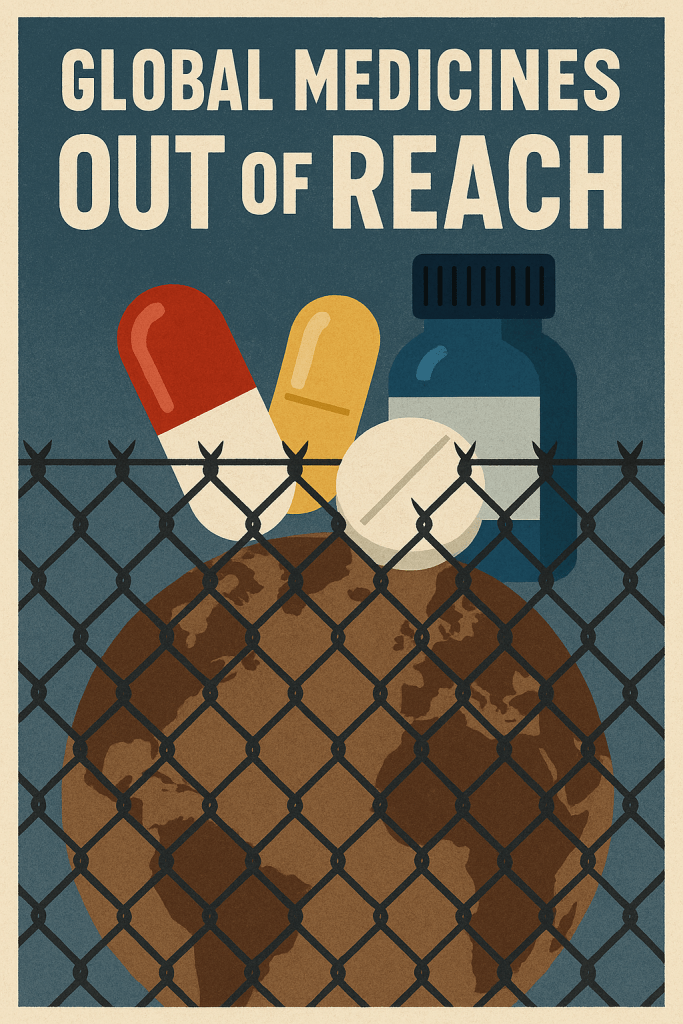
Imagine needing life-saving medicine—like antibiotics for an infection or insulin for diabetes—and discovering you simply can’t afford it, or worse, it’s not even in stock. For over two billion people worldwide, this isn’t a hypothetical scenario; it’s daily life.
A groundbreaking study published in The Lancet Global Health by Lachlan Oldfield and colleagues uncovers the current reality of medicine access in 54 low- and middle-income countries (LMICs). Using standardized surveys from WHO and Health Action International (HAI), the study reveals startling disparities in medicine prices, availability, and affordability across the globe.
What Was Studied and Why It Matters
The right to health, including access to medicines, is enshrined in the Universal Declaration of Human Rights. Yet, decades after this milestone, millions still struggle to obtain even the most basic drugs.
This study set out to measure:
- Availability – Is the medicine even present in the pharmacy or clinic?
- Affordability – How many days of wages are needed to afford a full treatment?
- Pricing – How do local prices compare to international benchmark prices?
The analysis covered 71 surveys across 54 countries using the WHO–HAI survey method, which is designed to generate directly comparable data on medicine access across public and private health sectors.
Key Findings at a Glance
Here’s what the data tells us:
- Availability of essential medicines is poor, particularly in the public sector.
- Prices are often outrageously high, especially for brand-name drugs.
- Treatments are unaffordable, frequently costing more than a day’s wage—even for the cheapest generic versions.
This means that people are often forced to go without medication, delay care, or make dangerous compromises—like sharing pills or buying incomplete doses.
Availability: The Medicine is Often Just Not There
The WHO recommends that at least 80% of essential medicines should be available at all times. But this target is rarely met.
Public Sector Availability:
- Very low in many countries, such as Congo (9.9%) and Burundi (12.1%).
- Only Iran (94.6%) and Colombia (92.8%) reported public sector availability near the 80% mark.
- Regional disparities were stark—Africa had a mean availability of just 37.6%.
Private Sector Availability:
- Generally better than the public sector.
- However, originator brands (the original patented versions) were still poorly stocked—as low as 3% in Tanzania.
- Some bright spots like Iran, Syria, and Afghanistan had availability of generics above 90% in the private sector.
Takeaway: Public clinics often fail to stock essential medicines, leaving patients to rely on private pharmacies—if they can afford it.
Price: Too Much for Too Little
To compare prices fairly, researchers used the Median Price Ratio (MPR)—the local price divided by an international reference price. An MPR of 1 means the price is fair. Anything above 1 means patients are paying more than they should.
What they found:
- Lowest-priced generics were 3 to 11.5 times the reference price in private sectors.
- Brand-name medicines were over 25 times the reference price—and up to 135 times in extreme cases like fluoxetine (an antidepressant) in the Americas.
- Even in public sectors, price ratios were high, showing governments struggle to negotiate better deals or maintain stock.
Example: Amoxicillin (a common antibiotic) in the Americas had an MPR of 25.3 in private pharmacies. This means a patient is paying 2,530% more than the international fair price.
Affordability: How Many Days of Work for One Medicine?
The affordability of a treatment was measured in days of wages required by the lowest-paid unskilled government worker. WHO’s benchmark: a full course of treatment should cost less than one day’s wage.
Reality check:
- A month of ranitidine (for ulcers) costs:
- 37 days’ wages in parts of Africa.
- 7–8 days in the Americas.
- Treating an infection with amoxicillin (7-day course):
- 3.2 days’ wages for the branded version in Africa.
- As low as 0.4 days in the Western Pacific—if generics are available.
- Asthma medication (salbutamol inhalers):
- Costs up to 4 days’ wages in some African countries.
A cruel irony:
Public sector medicines, when available, are often more affordable—but because availability is so low, patients are forced into the expensive private sector, which might be their only chance at timely treatment.
Progress Since 2009: Has Anything Changed?
This study serves as an important update to the influential 2009 review by Cameron et al., revealing both progress and persistent gaps in medicine access. While there have been some encouraging developments, particularly the improvement in the availability of generic medicines in most public health sectors, these gains are not consistent across all regions or income groups. At the same time, the availability of brand-name drugs has declined, which may reflect a shift in national policies prioritizing the use of more affordable generics. Notably, regions such as Europe and the Eastern Mediterranean have made significant strides in improving medicine access. In contrast, the Americas and the Western Pacific have seen little to no progress, with some areas experiencing a decline. Furthermore, private sector availability has dropped in upper-middle-income countries (UMICs), possibly due to reduced donor funding and the challenges these countries face as they transition away from international aid toward self-sustained health financing models.
What’s Driving the Problem?
Several interconnected factors contribute to the ongoing challenges in medicine accessibility. Supply chain inefficiencies are a major issue, particularly in rural or remote areas, where poor logistics and unreliable distribution systems frequently lead to stockouts of essential medicines. Financial barriers further compound the problem; even low-cost medicines become unaffordable when daily wages are extremely low, forcing many families to make heartbreaking choices between purchasing medication and meeting basic needs like food and shelter. Weak policy enforcement exacerbates these issues, as few countries have effective regulations in place to control private sector medicine pricing. Additionally, laws that mandate generic substitution or encourage bulk procurement are often inconsistent or entirely absent. A critical data gap also hampers progress: the Management Sciences for Health (MSH) international reference pricing system, once a cornerstone for fair price comparison, was discontinued in 2015. Without an updated global pricing benchmark, policymakers struggle to negotiate fair prices or accurately assess medicine affordability trends, leaving both procurement and policy decisions based on outdated or incomplete data.
Limitations of the Study
Though the WHO–HAI method is a powerful and standardized tool for evaluating medicine access across countries, it does have notable limitations. One major constraint is that it captures data at a single point in time, which can miss seasonal variations in medicine availability due to supply chain fluctuations or disease outbreaks. Additionally, it tends to underestimate real-world affordability by relying on the wage of the lowest-paid government worker, without accounting for informal sector earnings, regional differences in cost of living, or other hidden expenses such as transportation to health facilities. The method also focuses on the availability of specific formulations of medicines, often overlooking the presence of therapeutic equivalents or alternative dosage forms that could serve the same clinical purpose. Furthermore, it does not assess the quality of medicines or address the prevalence of counterfeit or substandard drugs, which can have serious public health implications. Despite these limitations, the WHO–HAI method remains the most widely used and consistent framework for cross-country comparisons, offering critical insights into how global health systems perform—and where they fall short—in ensuring access to essential medicines.
A Path Forward: What Needs to Be Done
This study is far more than an academic exercise—it is a compelling call to action. To address the ongoing crisis in medicine accessibility, several key strategies must be urgently implemented. First, there is a pressing need to strengthen the public sector supply chain. This includes increasing funding for the procurement of essential medicines and enhancing logistical components such as warehousing, transportation, and demand forecasting systems to reduce stockouts and improve distribution, especially in rural areas.
Second, promoting the use of generic medicines is essential. Health systems should encourage prescriptions to be written using international non-proprietary names (INNs), ensuring patients receive the most affordable and effective treatment available. Alongside this, governments must implement and enforce mandatory generic substitution policies, allowing pharmacists to automatically substitute high-cost originator brands with lower-cost generics where appropriate.
Third, regulating medicine prices in the private sector is crucial to protect consumers from excessive costs. This can be achieved by capping retail pharmacy markups and improving price transparency so that both health authorities and the public can make informed decisions and detect price gouging.
Fourth, investing in local pharmaceutical production will help reduce dependence on imports and enhance national medicine security. Supporting domestic manufacturing of quality-assured generics can lower costs and improve availability across both public and private sectors.
Finally, there is an urgent need for the World Health Organization and international partners to update global medicine pricing benchmarks. Since the discontinuation of the Management Sciences for Health (MSH) price guide in 2015, a new, inflation-adjusted international reference price system is needed to accurately monitor affordability and guide procurement and pricing policies worldwide.
Conclusion: Medicine is a Right, Not a Luxury
The findings from Oldfield et al. are clear: despite some progress, the world is far from ensuring fair access to essential medicines. For millions, the pharmacy remains a place of false hope, not healing.
In the 21st century, no one should suffer or die simply because the right pill is too expensive—or missing from the shelf. We have the knowledge, tools, and economic power to fix this. What’s missing is coordinated, courageous action.
Let this study serve as a wake-up call—for policymakers, health professionals, and global leaders alike. The time to act is now.
- The Rise of Cosmetic Culture and the Obsession to Look Beautiful
- Global Meta-Analysis of Antibiotic Resistance Trends in Urinary Tract Infections (UTIs)
- How Smart Glasses Help the Deaf Understand Conversations: The Science Behind the Tech
- Unexpected Acceleration in Earth’s Rotation: Implications for Timekeeping in 2025
- Early Blood Viral Load as a Predictor of Mpox Severity: A Meta-Analytical Review


You must be logged in to post a comment.